Find the revenue your hospital already earned but never billed.
Nexus OneHealth runs OPD, IPD, pharmacy, diagnostics and billing on one local-first platform — then continuously checks its own output for what never made it onto the bill.
Runs against the HMS you already have. Nothing to install, no commitment to replace anything.
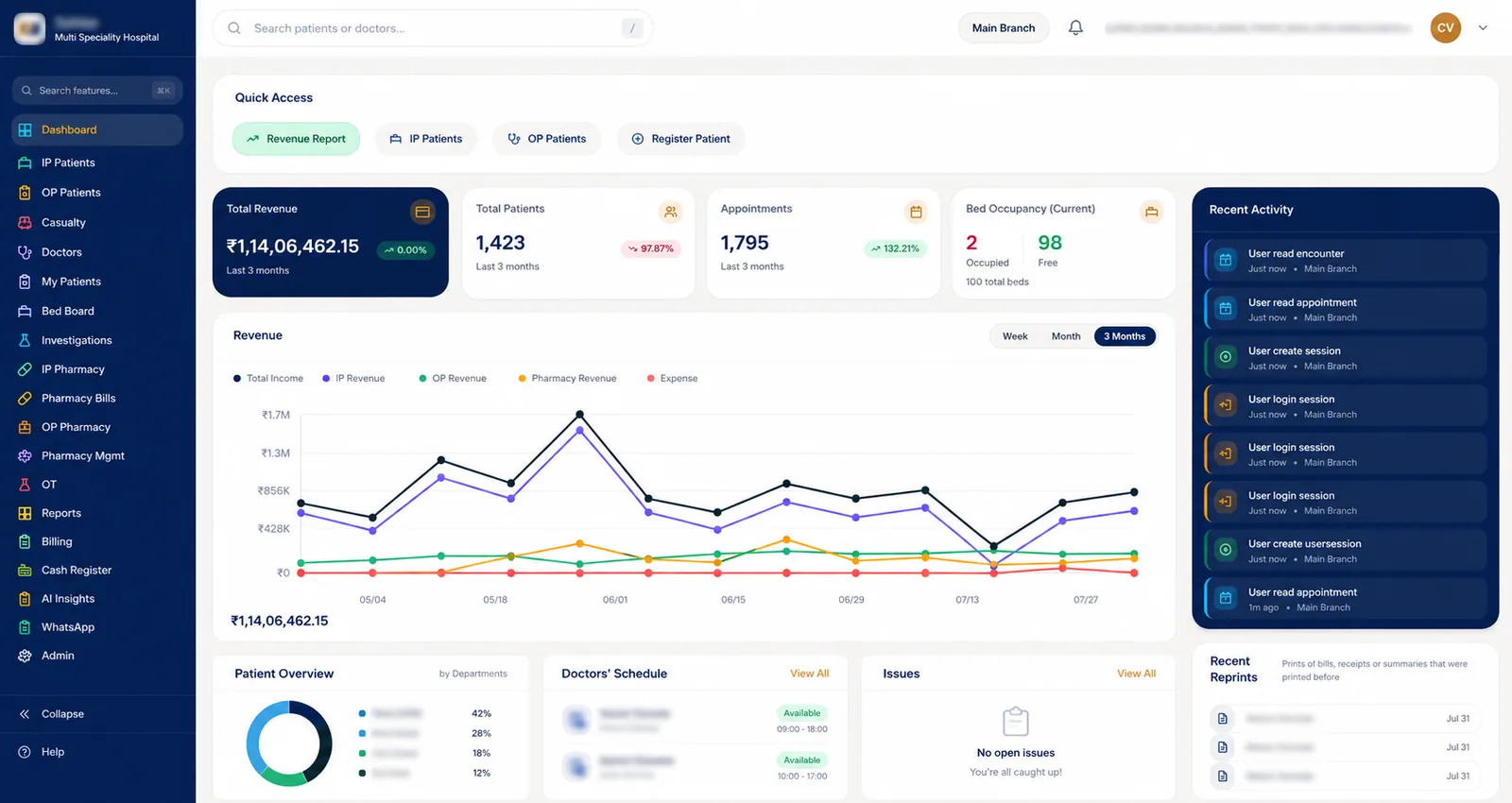
Nexus OneHealth — Dashboard
Measured at a live 100-bed multispeciality hospital
₹2.2 lakh
Revenue recovered
every month, at 100 beds
2 months
Payback period
from go-live
3 h → 20 min
Discharge turnaround
order to gate pass
1 h → 5 min
Insurance paperwork
per claim
What switching costs you
Six zeros.
Changing hospital systems is usually a bill, a project and a bad month. We have taken all three off the table — because the only way to sell a system to a hospital that has been burned before is to carry the risk ourselves.
Zerodisruption to operations
Both systems run in parallel on real patients. You reconcile the two daily, and nothing is switched off until the numbers agree.
Roll back any time during the parallel run
Zerodowntime
Admissions, dispensing and billing carry on while the data moves. The system runs on-premise, so a lost internet link does not stop you either.
None since Feb 2026
ZeroIT overhead for you
Migration, configuration, training and on-site go-live are ours. Your IT team does not have to staff the project or carry the system afterwards.
No internal project team required
Zerovariable costs
The server sits in your hospital, so there is no metered cloud bill that moves with usage. Your costs are known in advance and do not rise because you had a busy month.
Your cost is fixed at signing
Zerosetup cost
Standing up the on-premise server — installation, configuration, commissioning and network setup — is our work, not your bill. No setup fee and no implementation charge appear on your quote.
₹0 for installation and commissioning
Zeronet cost
At the hospital we measured, the leakage the system recovers each month exceeds what the system costs. It funds itself out of revenue you had already earned.
₹2.2 lakh recovered vs ₹40–50k cost, at 100 beds
The detail behind each of these — the parallel run, the rollback position, what we do and do not charge for — is set out below.
Evidence
What changed at a hospital like yours.
One hospital, running the full system in production. These are operating numbers taken from the hospital's own books before and after — not projections, and not a pilot.
Case studyTelangana
A 100-bed multispeciality hospital running OPD, IPD, pharmacy, diagnostics and billing on Nexus OneHealth.
The hospital had run on software it built for itself twelve years earlier. It had carried them a long way — but a system of that age is held together by the people who remember why it works, and those people move on. Replacing it meant moving a decade of patient records, pricing and stock without pausing a working hospital for a single day.
₹2.2 lakh
Leakage recovered per month
recurring, not a one-off
2 months
Payback period
from go-live
3 h → 20 min
Discharge turnaround
discharge order to gate pass
20 → 5 min
Bed turnover
vacated to ready for the next patient
+150%
OPD throughput
patients seen per clinic session
1 h → 5 min
Insurance paperwork
per claim, preparation to submission
“We had run our own system for twelve years, so the changeover was the part I was most worried about. Their team handled it and we did not lose a day. What surprised me since is how much was slipping through on the billing side — the management can see it now, and it adds up.”
Revenue Integrity is sold on its own. It reads from your current system and reports what was performed but never billed — without touching a clinical workflow, and without asking your staff to learn anything new.
No change to your existing HMS
No clinical workflow disruption
No staff retraining
You keep the findings whatever you decide next
If the findings do not justify the cost, you have lost nothing. If they do, you have a number your CFO can act on.
Free revenue leakage assessment
We look at a defined period of your existing billing, pharmacy and order data, and report what is missing from it.
Revenue does not leak dramatically. It leaves in small, boring, invisible ways.
No single missed charge is worth chasing. That is exactly why they accumulate. Rules run continuously across admissions, orders, theatre, pharmacy stock, consumables, billing changes and insurance settlements — and each finding goes to the person who can still fix it.
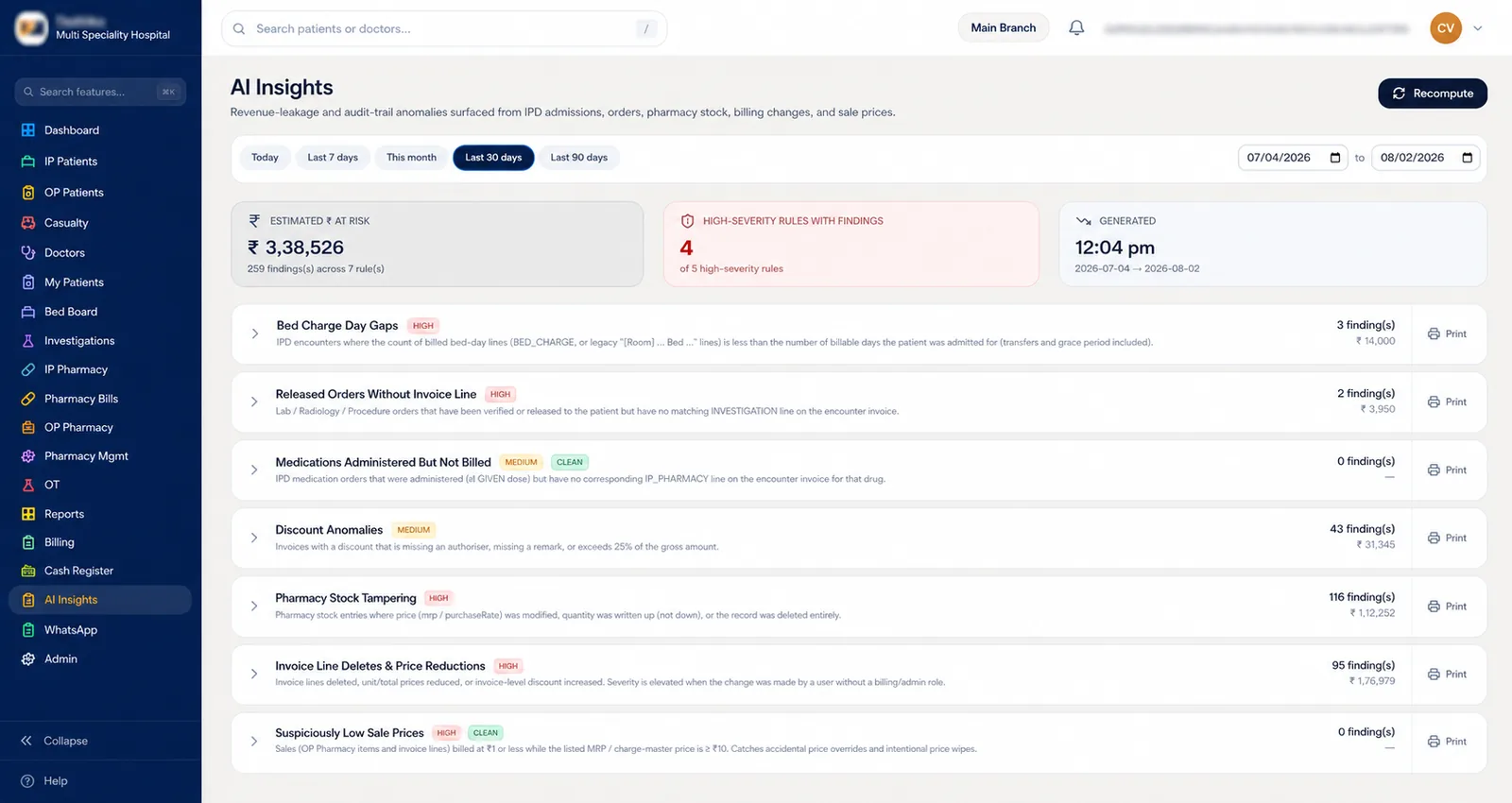
Findings are grouped by rule with a rupee value against each, so management can see where the money went before deciding what to chase. Any rule can be run over any date range and printed.
Bed Charge Day GapsHigh
IPD encounters where the billed bed-days come to less than the days the patient was actually admitted for — transfers and grace periods included.
Released Orders Without Invoice LineHigh
Lab, radiology and procedure orders verified or released to the patient with no matching investigation line on the invoice.
Medications Administered But Not BilledMedium
IPD medication orders with at least one dose recorded as given, but no corresponding pharmacy line on the encounter invoice for that drug.
Discount AnomaliesMedium
Invoices carrying a discount with no authoriser, no remark, or above 25% of the gross amount.
Pharmacy Stock TamperingHigh
Stock entries where the price was modified, the quantity was written up rather than down, or the record was deleted outright.
Nexus OneHealth — AI Insights
Invoice Line Deletes & Price ReductionsHigh
Lines deleted, prices reduced or invoice-level discount increased — escalated when the change came from a user without a billing or admin role.
Suspiciously Low Sale PricesHigh
Items billed at ₹1 or less against a listed price of ₹10 or more. Catches accidental overrides and deliberate price wipes alike.
OT & procedure charges
Procedures recorded in theatre with no matching charge on the invoice — including the second procedure added mid-list, which is the one that usually goes missing.
Ward & OT consumables
Sutures, implants and disposables issued against a case but never charged. Individually small, and the largest silent loss in most hospitals once totalled.
Claim rejection causes
Documentation and coding gaps that get claims rejected, flagged before submission while the file can still be corrected rather than six weeks later.
Short-paid claims
A settled claim is not a paid claim. Every remittance line is matched against what was billed, so TPA deductions get challenged instead of quietly absorbed.
Tuned to your hospital, not ours.
Every rule is configurable. Thresholds, severity and what counts as an exception are set against your charge master, your discount policy and your grace periods — because a 25% discount that needs an approver at one hospital is routine at another. Rules you do not want are switched off, and rules you need that are not here get written.
Whether this pays for itself is yours to check, not ours to assert.
Revenue Integrity finds what you did and did not bill. Care gaps find what should have happened and never did — the post-op review nobody booked, the diabetic who stopped attending, the result nobody acted on. Better medicine, and a visit you never billed because it never happened.
Chronic care review overdue
Diabetic, cardiac and renal patients carry a review interval. When the date passes without a visit, the patient surfaces on the worklist rather than quietly disappearing.
Post-procedure follow-up never booked
Every procedure can generate a follow-up with a due date. If it is never scheduled or never attended, it is flagged instead of closed.
Lab review nobody acted on
A released result with no follow-up encounter against it is a gap in care and an unbilled visit at the same time.
Vaccination and immunisation due
Scheduled doses track against the due date, so a child or adult falling out of a schedule is visible before the window closes.
Missed appointments
Appointments are marked no-show automatically through the day, and the patient goes into outreach the following morning.
How it runs
1
Detect
Runs every day against due dates, no-shows and open follow-ups.
2
Prioritise
Gaps carry a type and urgency, so clinical risk outranks routine recall.
3
Remind
The reminder goes out from inside the platform — WhatsApp, SMS or email.
4
Close
Booking an appointment closes the gap and links it back to the encounter.
Reminders go out over WhatsApp by default — the channel patients actually read, at a fraction of the cost of SMS.
Protocol-driven detection
Gaps are derived from the diagnosis itself, not only from a follow-up someone remembered to raise. Every diabetic overdue for an HbA1c, every patient eligible for a screening they have not had — the system reads the clinical record against the protocol and surfaces the gap without anyone creating a reminder first.
That is the difference between a recall list and a clinical safety net: it catches the patients nobody thought to add.
Modular by design
You do not have to replace everything at once.
The platform is modular and we sell the modules separately. Take one department, run it properly, judge us on it — then decide whether the next one follows.
Lowest risk
Revenue Integrity
Runs alongside your existing HMS. Changes nothing clinically.
Start here if you suspect leakage but cannot justify a system change yet.
Billing
Charge master, invoicing, payments, deposits, refunds and audited discounts.
Start here if billing is the bottleneck at discharge.
Pharmacy
IP dispensing and OP counter sale, each with its own stock and inventory.
Start here if stock and dispensing do not reconcile with what was charged.
OPD queue
Doctor schedules, token-based queueing and front-desk registration.
Start here if the outpatient waiting area is the visible problem.
IPD
Admissions, bed board, ward services, nursing records and the full discharge workflow.
Start here if discharge is slow and beds sit idle between patients.
Lab (LIS)
Order entry, technician worklist, result entry and release back to the clinician.
Start here if lab results still move on paper between departments.
Whatever you keep, we integrate with.
Taking one module does not orphan the rest of your estate. If you already have a lab system you are happy with, keep it — we integrate rather than insist.
Investigations can be sent to an outside lab and come back into the same worklist
Lab, pharmacy and billing exchange data with systems you keep
One department can move without forcing the others
We migrate the data at our cost, and you can stop at any point
The real question isn't features. It's what happens to your data.
Every administrator who has lived through a bad migration is right to be cautious. A hospital cannot pause admissions while a vendor works out why the balances do not tie. So we carry that risk instead of asking you to.
1
We migrate your data, and we pay for it
Patient records, drug master, charge master and pricing are brought across from your legacy system by us, at our cost — and your hospital keeps running throughout. Admissions, dispensing and billing carry on with no downtime while the transfer happens. Migration is not a line item on your quote.
2
Both systems run in parallel
For an agreed period your existing system stays live alongside ours. You reconcile the two on real patients before anyone commits. Nothing is switched off on day one.
3
Our team owns your go-live and supports you throughout
Not a ticket queue. The same team is accountable from the first data pull to sign-off, and stays with you afterwards — you deal with people who already know your hospital, not a rotating support desk.
4
An on-site technician for onboarding
We put a technician physically in your hospital for the switchover and the days after it, when the real questions arrive at the counter.
5
You can walk back
Your legacy system stays intact and authoritative through the parallel run. If the reconciliation does not satisfy you, you stop — data exported in open formats, no penalty.
It carries your hospital's name, not ours.
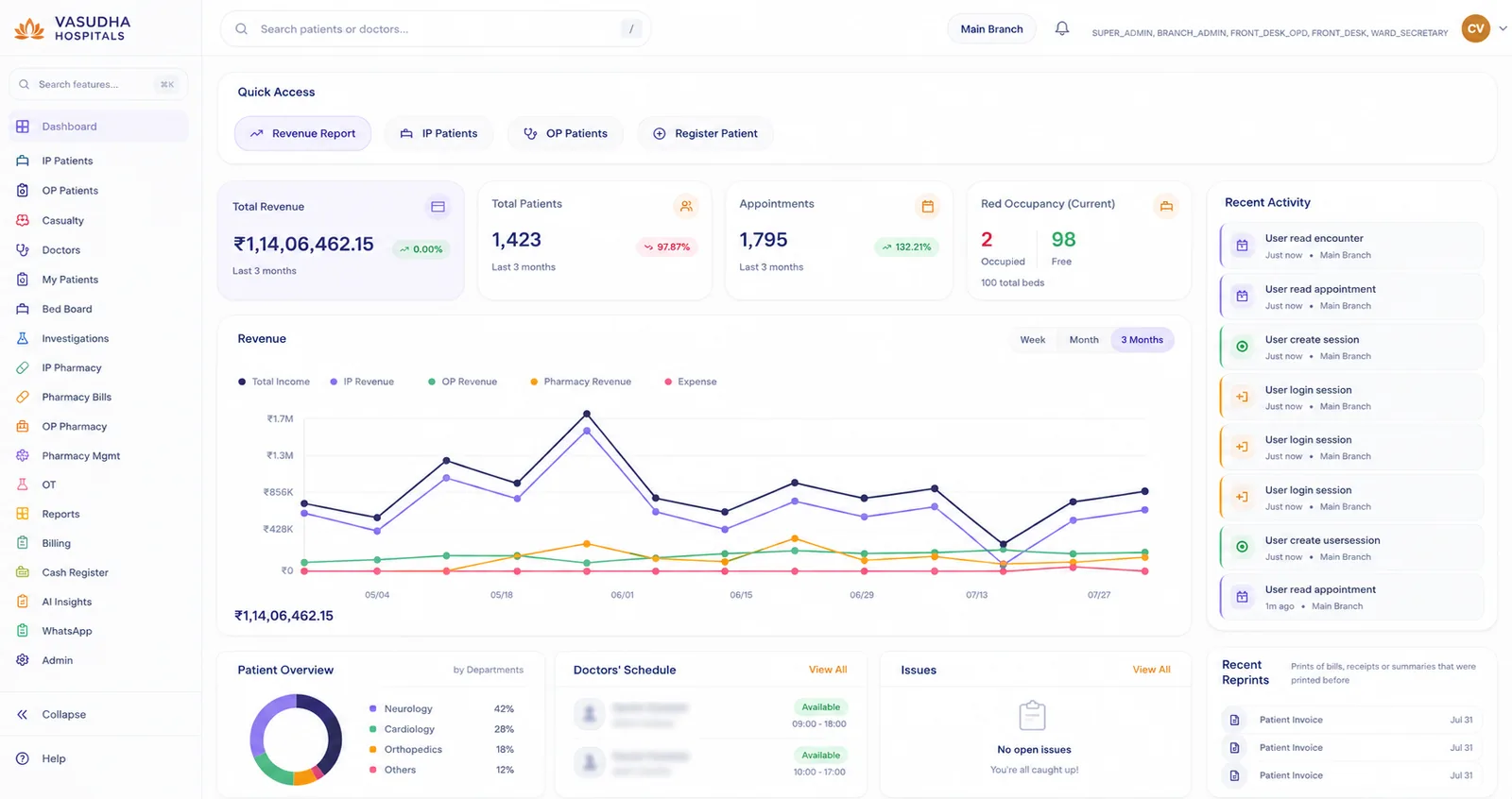
The screen beside this is the same platform, running as another hospital. Your staff are learning your system, not a vendor's.
Your logo and colours across every screen
Your hospital name on prescriptions and invoices
Your letterhead on discharge summaries
Patients never see a third-party brand
Vasudha Hospitals — the same platform
Coverage
For when you do want the whole thing.
This list answers “does it cover us?” — it is not the argument. Every module below is in production today, and each can be taken on its own.
Patient Management
OPD and IPD registration, automatic MRN generation, duplicate detection and record merging, and full longitudinal history.
Appointments & Queue
Doctor schedules with exceptions, token-based queue management, and both list and token views for the front desk.
Clinical Documentation
Encounters, configurable vitals, prescriptions, structured notes and casesheet uploads — with medical symbol shortcuts in every field.
Orders & Investigations
Lab, radiology and procedure orders with a technician worklist, result entry, file attachment and full status tracking.
Pharmacy
Separate IP dispensing and OP counter-sale POS, each with its own stock and inventory, ward indents and a shared drug master.
Billing & Revenue
Charge master, invoices, payments, deposits and refunds, with editable investigation pricing and audited discount remarks.
Bed Management
Real-time bed board across facility, building, floor, ward, room and bed, with live occupancy and cleaning status.
DICOM Imaging
Cornerstone-based viewer integrated with an Orthanc DICOM server, including 3D reconstruction for cross-sectional studies.
Discharge Summaries
Structured discharge workflow producing print-ready PDFs on your hospital letterhead, including transfer and shift-out forms.
Admissions, occupancy, department mix, doctor workload and collections — and if the report your management wants is not here, we build it rather than asking you to export to Excel.
CRM & Engagement
Follow-up tracking, appointment reminders, no-show capture and patient communication with reusable templates.
WhatsApp built in
Reports, bills, reminders and recall campaigns go out over WhatsApp from inside the platform — at a fraction of the cost of SMS.
Care Gaps
Overdue chronic reviews, unbooked post-procedure follow-ups and missed appointments are detected daily, with reminders sent automatically.
AI Insights — built around you
Not a fixed dashboard. We configure the insights module to the questions your management actually asks, and extend it as those questions change.
Staff Attendance
Attendance integrates with the platform, so duty records sit against the same staff accounts used everywhere else — one source for who was on shift.
Roles & granular permissions
Set access per staff member, not per department. 13 roles and 47+ individual permissions decide exactly what each person can see, edit, print or export — with branch-scoped data and controlled cross-branch access.
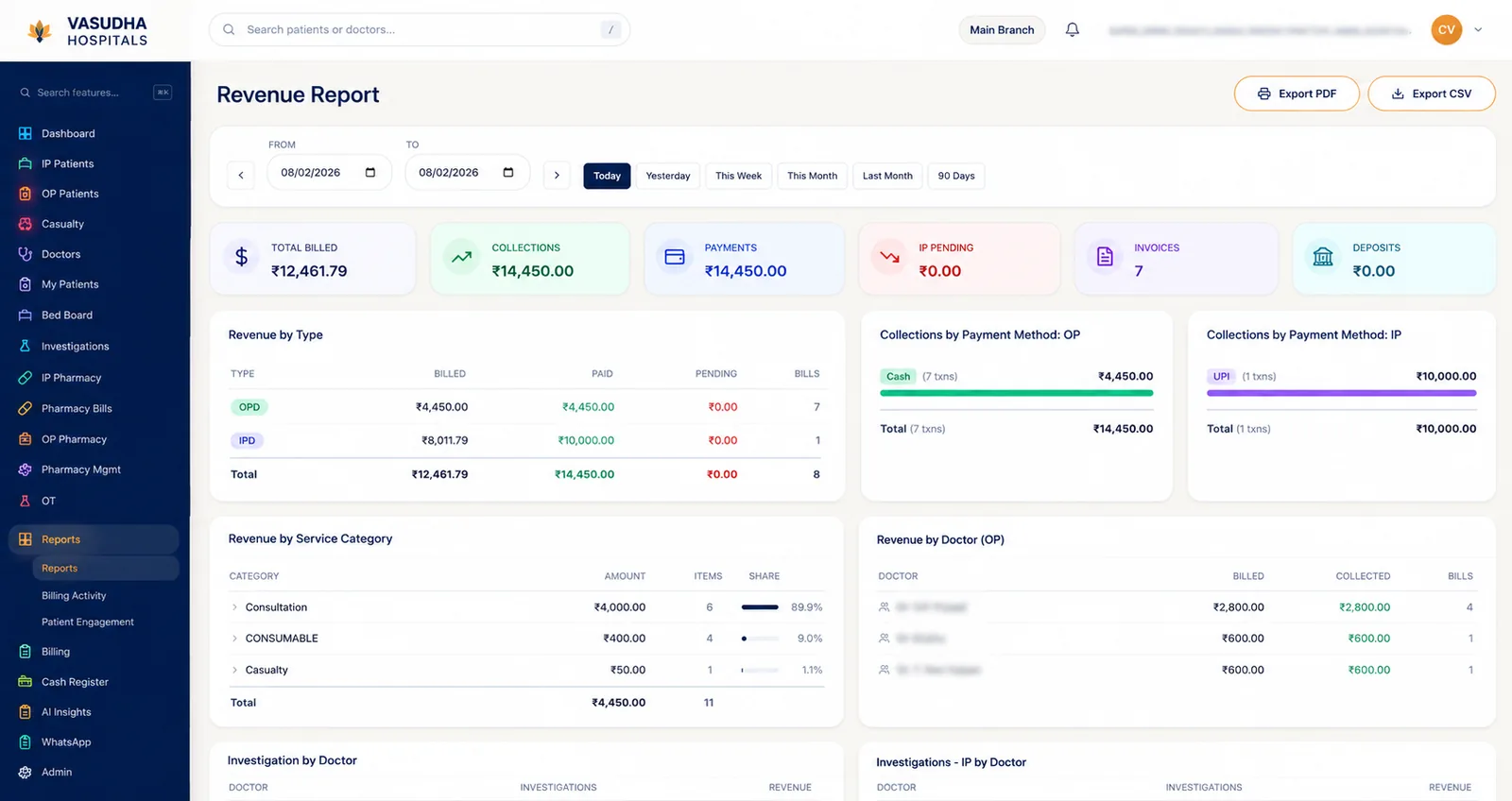
The revenue report your management already asks for.
Billed against collected against pending, for any period — split by OPD and IPD, by payment method, by service category and by doctor. Exportable to PDF or CSV.
Today, yesterday, week, month or any custom date range
Collections split by cash, UPI, card and bank transfer
Revenue attributed by doctor, for both consultation and investigations
If the report you need is not here, we build it — reports are configurable
Nexus OneHealth — Revenue Report
Everything is a keystroke away.
A hospital system is used a hundred times a day by people standing at a counter with a queue behind them. Search is everywhere, and it is fast.
Find a patient from anywhere
Search by name, MRN, ABHA number or phone from the bar at the top of every screen — no need to be on the right page first.
Jump to any feature
A command palette switches you to any module or tab by name, so nobody has to remember where a screen lives in the menu.
Find any bill or invoice
Search billing by invoice number, bill number, patient name or MRN — useful when a patient is standing there holding a printed receipt.
Search inside each department
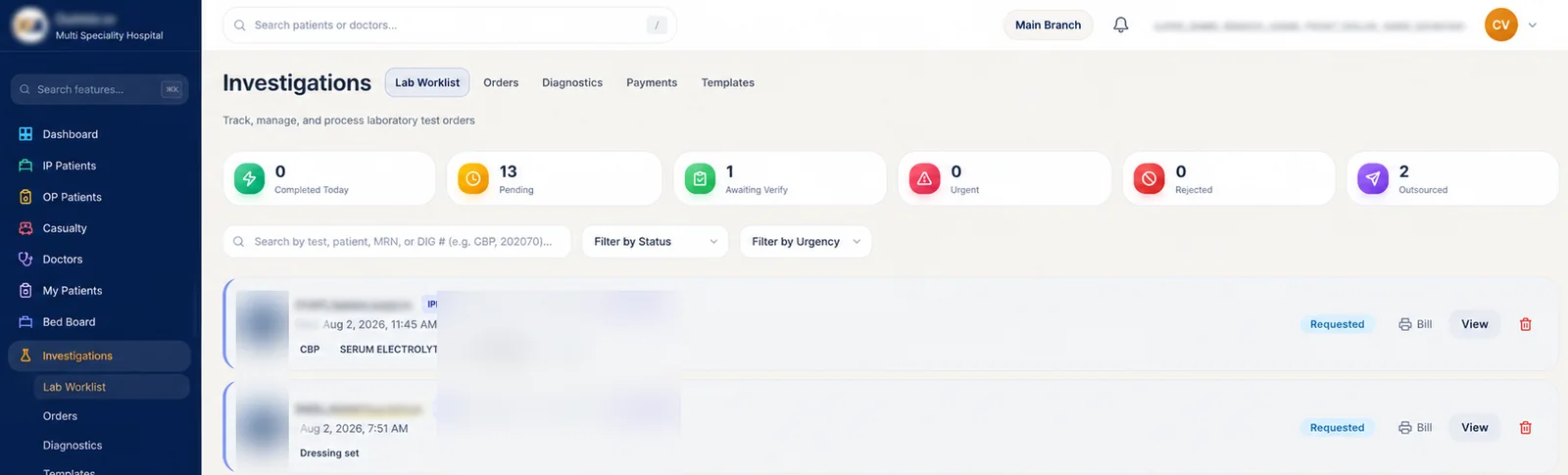
Lab searches by test, patient, MRN or order number. Pharmacy searches by patient, MRN or drug. Each worklist filters by status, urgency and date.
Multi-branch
Run every site from one system.
Groups running more than one hospital usually end up with one system per site and a spreadsheet stitching them together. This is a single deployment that already knows about all of them.
One combined view for management
Revenue, admissions, occupancy and leakage roll up across every branch into a single top-level picture, so the owner or MD is not reconciling separate reports from each site.
Switch into any branch
From the combined view, drop into an individual hospital and see it exactly as its own staff do — same screens, same numbers, no separate login.
Each branch sees only its own
Data is scoped per branch by default. Cross-branch visibility is granted deliberately, to the people who need it, and is logged like any other access.
Pricing set per branch
Charge master and tariffs are configured for each site, so a group running hospitals at different price points does not have to compromise on one shared list.
Staff who work across sites
Doctors and administrators can be given access to more than one branch without duplicate accounts, and their activity stays attributable in each.
Adding a branch is configuration
A new site does not mean a new deployment, a new database or a new contract to negotiate from scratch.
Architecture
Local-first. Cloud optional.
Indian hospitals do not get to pause admissions because a fibre line is cut. Nexus OneHealth is built on-premise first — the cloud is there for backup and reach, never as a single point of failure.
Works when the internet does not
The database and application run inside the hospital. A broken link to the outside world does not stop admissions, dispensing or billing.
Cloud sync is a choice, not a condition
Optional encrypted delta sync gives you off-site backup and remote access for consultants. Switch it off and nothing leaves the premises.
Your data stays yours
On-premise PostgreSQL with scheduled, verifiable backups. No lock-in to a vendor cloud, and no per-record hostage-taking on exit.
The server is your capital asset
You own the hardware and it sits on your balance sheet, rather than renting capacity by the month. It is configured for disaster recovery and to meet the compliance requirements your auditors check.
No variable cloud costs
Nothing is metered. A busy month does not produce a larger bill, and your running cost is known in advance instead of moving with usage.
Deployment topology
Inside the hospital
Web application
Application server
PostgreSQL database
DICOM / imaging
Reachable only from the hospital network and approved VPN devices.
encrypted delta sync · optional
Cloud — if you want it
Off-site backup
Remote consultants
Standards
What your IT head will ask about.
We list only what we can evidence on request. Anything marked below is exactly that — we would rather tell you now than during procurement.
HL7 / FHIRSupported
Interoperability with labs, PACS and external systems.
DPDP Act 2023Supported
Audit trails, access control and data export on demand — built to meet your obligations as data fiduciary.
ABDM / ABHAIn process
ABHA number capture is live. Full health-record linkage is in progress.
NABH documentationSupported
Records, consent and audit trails structured to supply the evidence NABH assessors ask for.
Most HMS projects do not fail on features. They fail in the six weeks around go-live, when staff are busy and nobody has time to learn a new system. That is the part we staff properly.
01
Discovery & configuration
We map your workflow, charge master, wards and departments, then configure the system around how your hospital already works — including white-labelling it to your brand.
02
Managed data migration — at our cost
We extract, clean and load your existing patient records, drug master and pricing, and reconcile every total with your team before anyone relies on it.
03
Parallel run
Both systems operate side by side on real patients for an agreed period. You compare the two daily. Nothing is switched off until the numbers agree.
04
Role-based training
Front desk, nursing, doctors, pharmacy, lab and billing are each trained on their own screens — short sessions, on your floor, in your workflow.
05
Supervised go-live, on site
Our technician is physically present for the switchover and the days that follow, when the questions actually arrive at the counter.
06
Review & optimisation
Once the system settles we return with the first Revenue Integrity findings and work through them with your management team.
It costs nothing, it runs against the system you already have, and it ends with a number rather than a proposal. If that number is small, we will tell you so.